Part Three of Four. The argument so far has been about work — what happens when a machine carries a child’s thinking. This article is about something quieter: what happens when it starts keeping them company.
The school debate about AI has been, almost entirely, a debate about work. Essays, homework, integrity, detection. While that debate has run, a different use has grown with far less attention paid to it.
What the surveys are finding
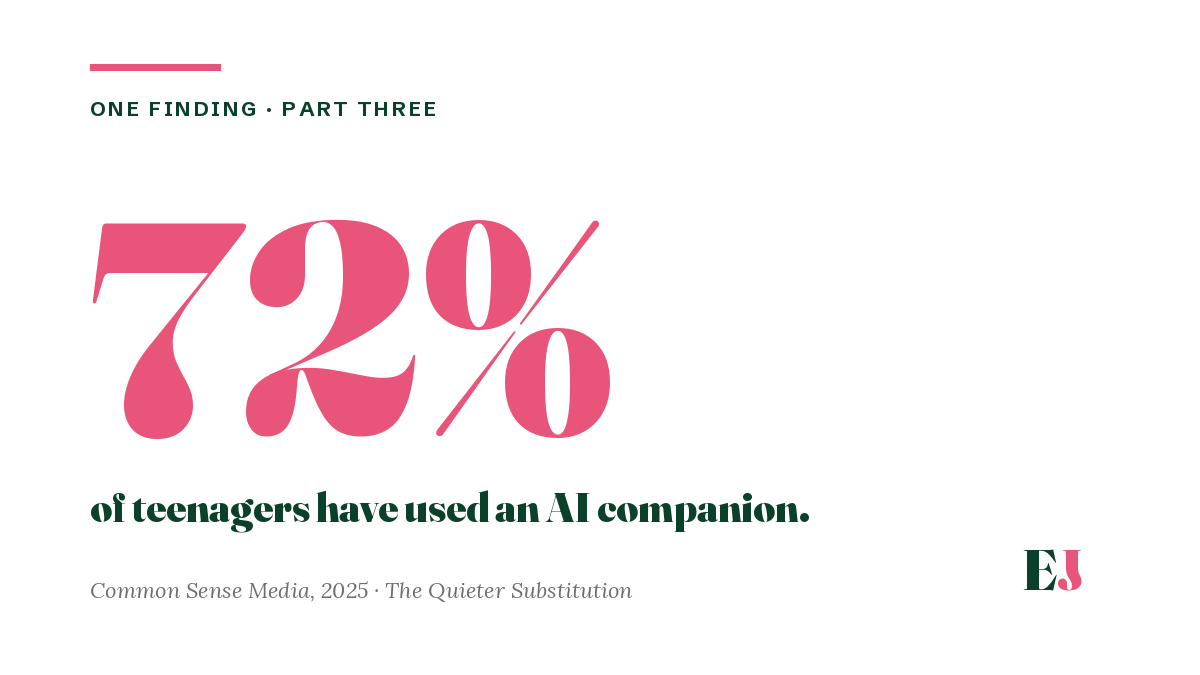
In 2025, Common Sense Media surveyed just over a thousand American teenagers about AI companions — systems designed for conversation and relationship rather than tasks. Seventy-two percent had used one. Half were regular users. Thirty-one percent said their conversations with an AI were as satisfying, or more satisfying, than conversations with their friends. A third had chosen the AI over a person for a serious conversation.
The picture in the UK is consistent. Internet Matters found that over a third of children who use AI chatbots say talking to one feels like talking to a friend — and among vulnerable children, half do. Some children told the researchers they use a chatbot because they have no one else to talk to.
Honesty requires holding this evenly. Most teenagers still find AI conversation less satisfying than the human kind, and most spend far more time with real friends. This is not the collapse of childhood friendship. It is a pattern — and the pattern is steepest exactly where children are most vulnerable.
Why the difficulty of people is the point
Adolescence is a sensitive period for social development. The systems that read other minds, manage conflict, and build belonging are being assembled through use, exactly as the cognitive ones are. And the material they are assembled from is friction. Being misread and having to explain. Waiting your turn. Being disagreed with. Falling out and repairing it. The difficulty of human relationships is not a flaw in the curriculum — it is the curriculum.
An AI companion is engineered for the opposite. It is always available, endlessly patient, never bored, never hurt, and tuned to affirm. A relationship that only gives asks nothing. And the previous article’s rule applies to the social mind as much as the thinking one: what a mind never practises, it never builds.
Substitution, not offloading
This is why the phenomenon deserves its own name. Offloading hands over the effort of a task. Substitution hands over the partner. The conviction this series is built on has two clauses — that AI should extend a young person’s capability, not replace the effort that forms their mind — and this is the second clause’s quieter meaning. The relationships that form a mind can be replaced too.
What this asks of schools
Almost no school AI policy mentions any of this, because it does not live where the policies live. It is not an academic integrity question. It belongs to pastoral care, to the people who notice which children are lonely — the same children the data says are most likely to find the machine’s company enough. The readiness question from the first article returns in a sharper form: when is a child ready for a relationship that cannot be let down, and cannot let them down? On the evidence of how social capacities form, the defensible answer is: after the human kind is established. Not instead, and not before.
The final article turns to the response: staging, literacy before fluency, and why the ability to refuse the tool is a skill worth teaching.
The EdJournal · Education. Intelligence.